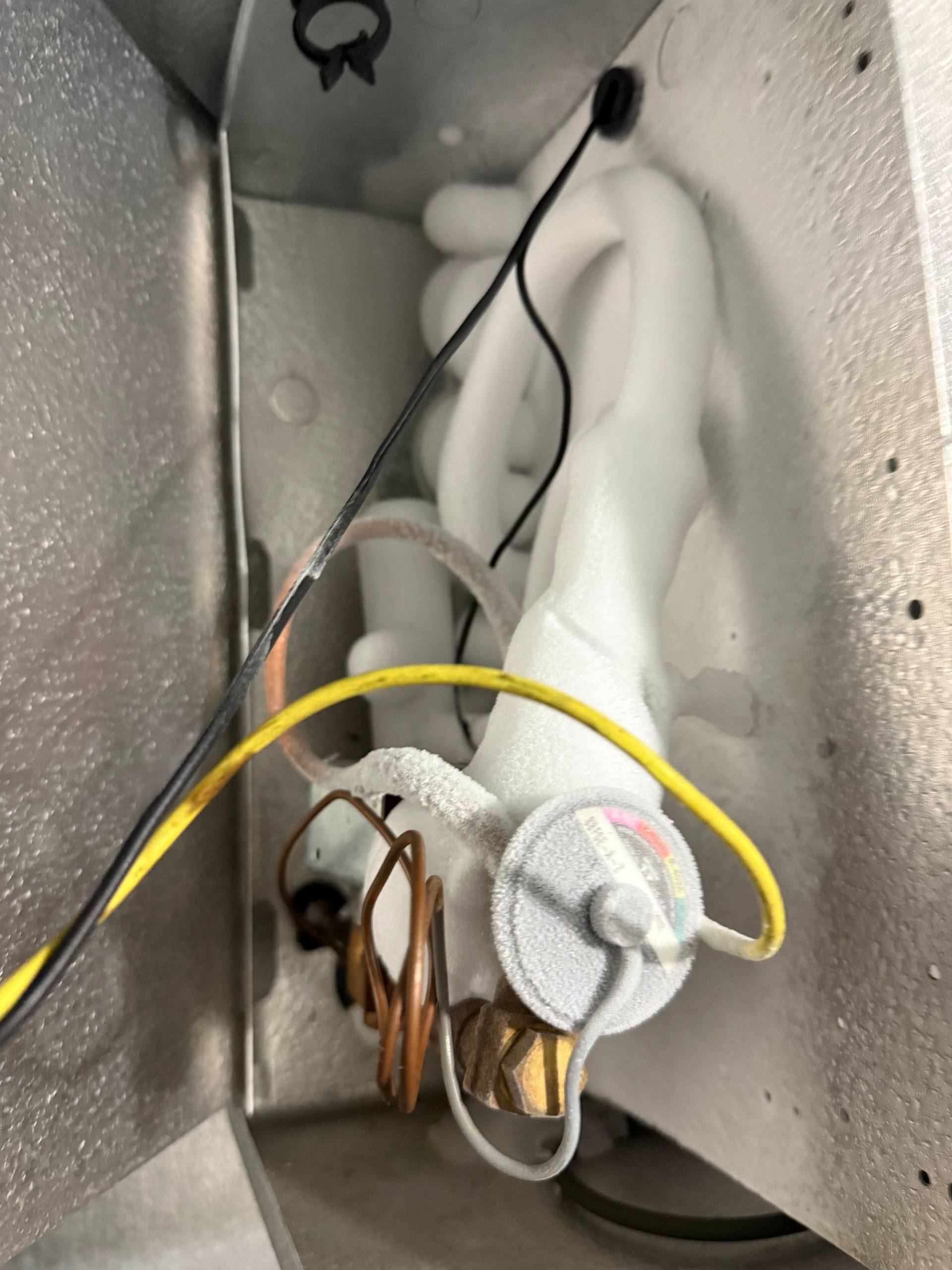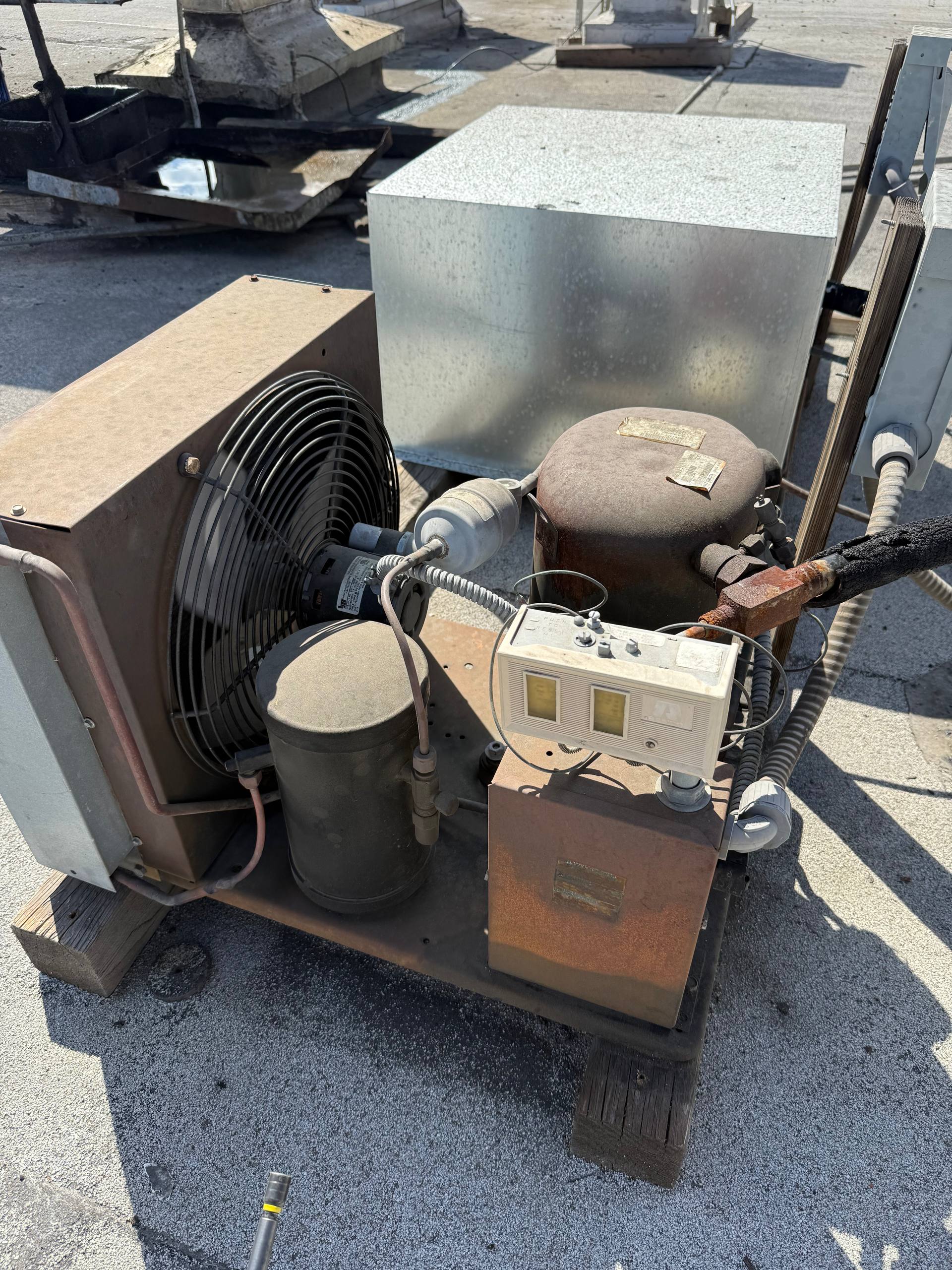
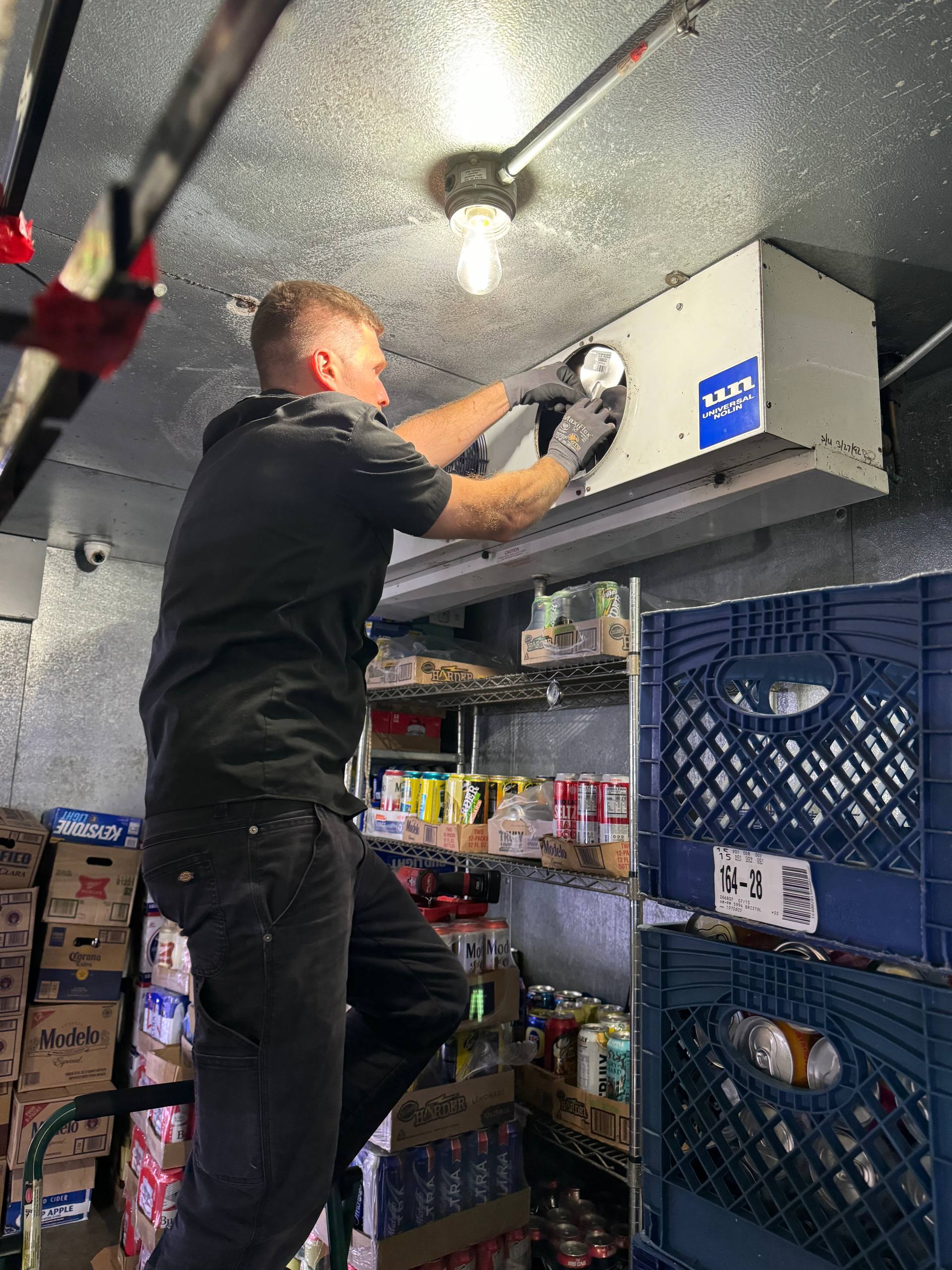
On this Vulcan walk-in refrigerator repair at a Costa Mesa store, three things needed attention: the evaporator fan motor and fan blade had to be replaced, the thermostat had to be replaced, and the condenser coil on the rooftop condensing unit needed a thorough cleaning. After all three, the unit ran like new.
The call came from a store in Costa Mesa with a Vulcan walk-in refrigerator. When I opened it up, the work broke down into three separate jobs on the same system: the fan assembly inside the evaporator, the temperature control, and the condensing unit up on the roof.
What did the walk-in refrigerator need?
Inside the evaporator, I replaced both the fan motor and the fan blade. The evaporator fan is what moves air across the coil and circulates cold air through the box. When that motor stops turning, or turns weakly, the coil can be cold while the food storage area warms up, because nothing is pushing the cold air out into the space. Replacing the motor and the blade together restores full airflow.
The thermostat on the same refrigerator also got replaced. The thermostat tells the system when to run and when to stop. A faulty one can let the box drift warm or run the compressor far longer than it should.
Why clean the condenser coil on the roof?
Because a dirty condenser coil makes the whole system work harder. The condensing unit for this walk-in sits on the roof, and its coil is where the system dumps the heat it pulls out of the box. When that coil is caked with dirt, heat has nowhere to go, pressures climb, cooling drops, and components wear out faster. I cleaned the coil as part of the same visit.
With the new fan motor and blade moving air, a new thermostat controlling the cycle, and a clean coil rejecting heat properly, the Vulcan walk-in was back to running the way it should.
What can you check yourself?
Two things are safe to look at. Stand inside the walk-in and listen for the evaporator fan; if you don’t hear it running while the unit is cooling, that’s worth a service call. And if your condensing unit is accessible, look at the coil. Visible dirt and buildup mean it’s due for a cleaning. Leave the actual repairs alone, though. A walk-in is a sealed refrigerant system running on commercial voltage, and that work needs a licensed technician.
FAQ
Why is my walk-in cooler running but not staying cold?
Often the airflow is the problem, not the refrigeration itself. If the evaporator fan motor has failed, the coil gets cold but the air in the box never circulates, so product temperatures climb even though the compressor runs. A bad thermostat can cause similar behavior by cycling the system at the wrong times. Both showed up on this Costa Mesa job, which is why the fan motor, blade, and thermostat were all replaced.
How often should a walk-in refrigerator condenser coil be cleaned?
For most commercial locations, a condenser coil cleaning every three to six months is reasonable, and rooftop units in particular collect grime quickly from outdoor exposure. Stores with dusty stockrooms or greasy air need it more often. Regular coil cleaning costs far less than the compressor failure that a chronically dirty coil can eventually cause, so it belongs on a maintenance schedule rather than a repair ticket.
Is it worth repairing a commercial walk-in refrigerator instead of replacing it?
Usually yes, when the failures are in serviceable parts. Fan motors, fan blades, and thermostats are all replaceable components, and swapping them costs a small fraction of a new walk-in installation. Replacement only starts to make sense when the box itself, the insulation, or the compressor is at the end of its life. This Vulcan unit needed parts, not retirement, and it came back to full performance.
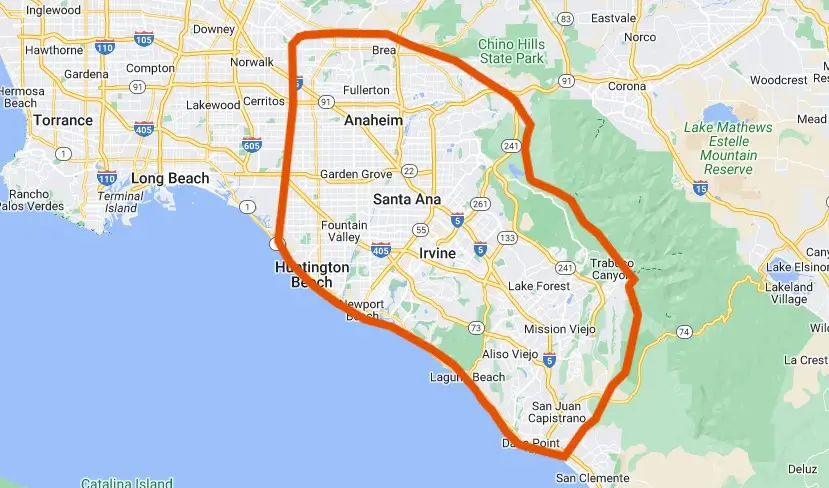
If your walk-in refrigerator isn’t holding temperature, we handle commercial refrigeration repair in Costa Mesa and the surrounding area. Call us and we’ll get a technician out to diagnose it.