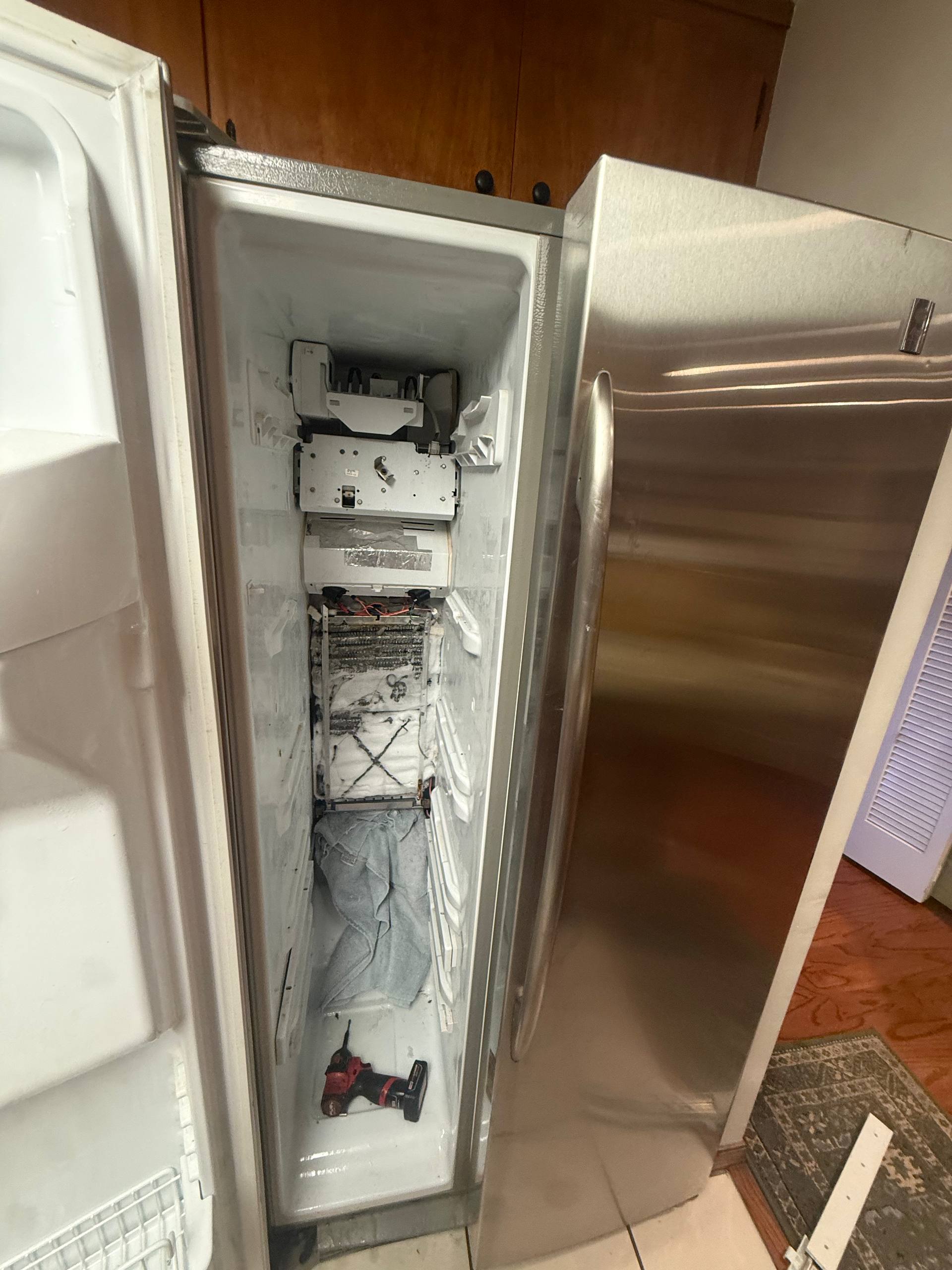
A GE refrigerator not defrosting usually traces back to the defrost heater, and that is what had failed here. The heater sits under the evaporator coil and melts frost off it during each defrost cycle. With the element dead, nothing clears. I installed a new GE heater and bracket assembly, part WR51X10055, on this PSS26MSWASS.
How the repair went
The defrost heater on this refrigerator sits under the evaporator coil behind the rear panel of the freezer compartment, so that panel comes off before anything can be tested or swapped. I went to the heater element first, because an open heater is the failure that stops defrost while the compressor and the fans keep running like normal. On this PSS26MSWASS in Santa Ana, the heater was the dead part, and GE sells it as a combined heater and bracket assembly, so the element and its mounting hardware came out and went back in as one piece.
Why does a refrigerator stop defrosting?
Four parts have to cooperate for a defrost cycle to do its job, and any one of them can stop it. The heater itself is a glass or metal tube element that carries line voltage for a few minutes every several hours; the element goes open with age and the circuit simply does nothing after that. The defrost thermostat, a small bimetal clipped to the coil, has to close when the coil is cold enough to let current through to the heater. The control board or timer has to call for the cycle in the first place. And the drain under the coil has to carry the meltwater away, because a drain plugged with ice refreezes the water right back onto the coil.
Frost that builds up on the coil blocks airflow, so the first thing most people notice is not ice at all. It is a freezer that still feels cold while the fresh food section drifts warm, since the air that cools the upper cabinet has to pass through that blocked coil first.
What can you check yourself?
Pull the freezer contents and look at the rear panel. If it is cold to the touch and sweating, or if you can see a sheet of ice through the vents, the defrost system is the place to look. Check that the evaporator fan runs when the doors are closed; on most models you can hear it change pitch as the compressor cycles. Make sure nothing is blocking the vents between the freezer and the fresh food side, and that the doors are sealing.
Past that, testing a defrost heater means working on a live line-voltage circuit inside the cabinet with the panel off, and that part is my job.
FAQ
How long does a refrigerator defrost heater last?
Most last well past ten years, which is why a failed one often shows up on a refrigerator that has never needed anything else. The element runs only a few minutes per cycle, but it heats and cools every time, and that expansion is what eventually opens the circuit. There is no maintenance that extends it. When it goes, the element is replaced, not repaired.
My freezer is cold but the fridge is warm. Is that the defrost system?
Often, yes. In most side-by-side and top-freezer designs, one evaporator coil cools both compartments, and air is routed to the fresh food section through a duct. When frost covers that coil, the freezer stays cold because it is closest to the ice, while the fresh food side loses airflow first. A failed evaporator fan motor produces the same pattern and gets checked at the same time.
Is a refrigerator that will not defrost worth fixing?
Usually it is. The defrost components are inexpensive compared with the sealed system, and the repair is a parts swap behind one panel rather than anything involving refrigerant. The question changes if the cabinet is old enough that the compressor is also near the end, or if the liner has been damaged by ice pushing against it. Those are worth looking at before ordering parts.
We handle refrigerator repair throughout Santa Ana and the rest of Orange County at Cactus Appliance. You can book a visit online or call us at (949) 544-5550.
Related repairs
- Samsung Refrigerator Ice Maker Not Making Ice: Fixed
- Refrigerator Not Turning On? It Was the Outlet
- The Software Our Appliance Repair Shop Runs On (and What We Used Before)